Artist
Biography
...
Jessie Oonark was born in 1906 near the Back River, a major
estuary in the north-central part of the Northwest Territories
(now Nunavut). Named after her paternal grandfather, Oonark (or
Una, as she is also called) was a member of the Utkusiksalingmiut,
a mainly inland dwelling group of Inuit who depended on fishing
and caribou hunting for their survival. Although the Utkusiksalingmiut were
already trapping and trading furs with the Hudson’s Bay
Company and its competitors at the time of her birth, Oonark
grew up in a strongly traditional milieu, mastering such customary
arts as the making of clothing from caribou skins. When poor
caribou hunting and a deteriorating global market for Arctic
fox furs forced the Utkusiksalingmiut to abandon their
semi-nomadic lifestyle in the late 1950s, Oonark followed other
members of the group to the new settlement of Baker Lake.
...
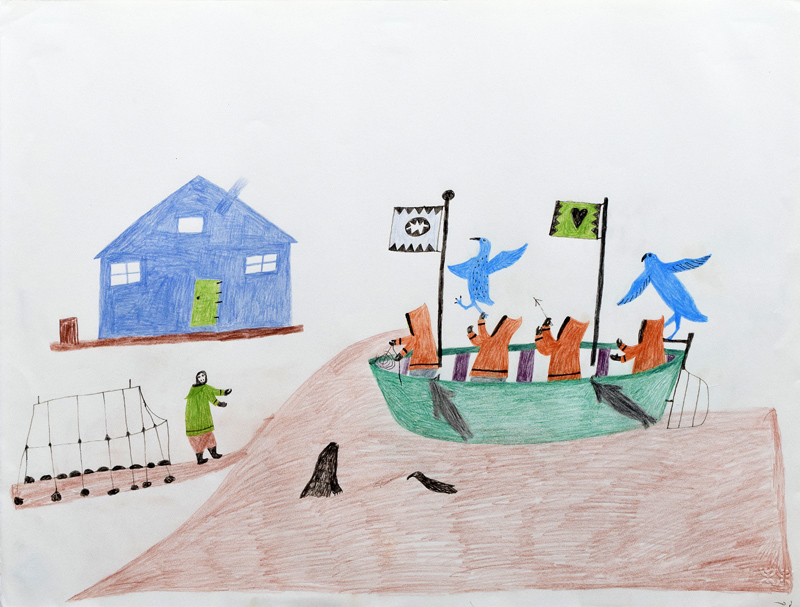
Oonark made her first drawings in
1959, using art materials supplied to her by Dr. Andrew Macpherson, a biologist
with the Canadian Wildlife Service. Her work instantly came to the attention
of printmakers in Cape Dorset, who included three prints based on her designs
in their 1960 and 1961 print collections. Oonark continued to draw throughout
the 1960s, selling images to the local crafts shop in order to support her
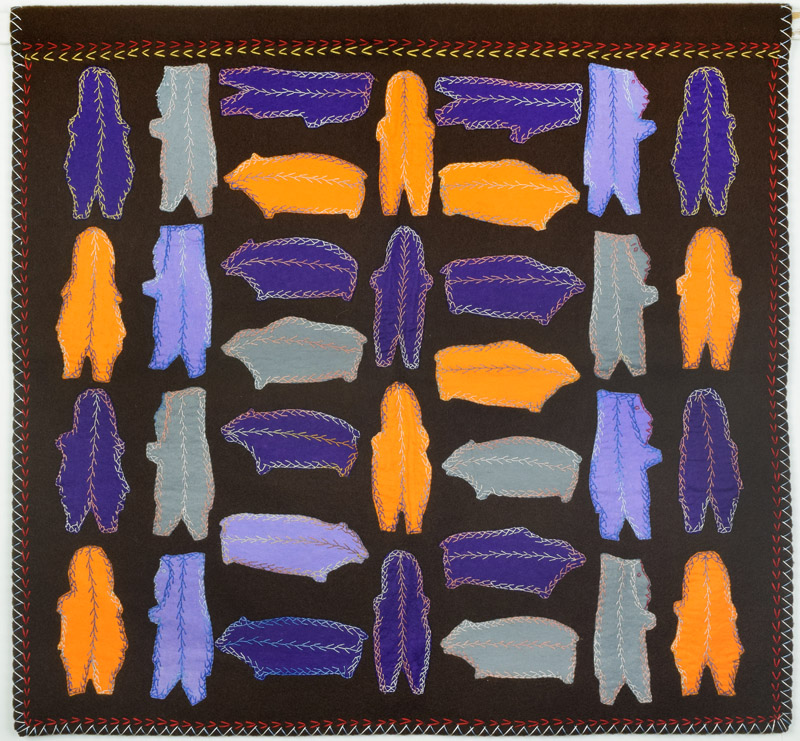
large family. She also began making embroidered and appliquéd wallhangings,
the form for which she would become famous. In 1970, Oonark’s drawings
were featured alongside John Pangnark’s sculptures in a two-person exhibition
presented by the National Museum of Man (now the Canadian Museum of Civilization).
That same year, she had her first solo exhibition at Toronto’s prestigious
Isaacs Innuit Gallery. A prolific artist with a legendary capacity for hard
work, Oonark contributed more than a hundred images to Baker Lake’s annual
collections between 1970 and 1985. Several of Oonark’s children became
widely recognized artists as well. Forced by a neurological disorder to stop
drawing and sewing in 1979, she continued to be honoured for her life’s
work, receiving her Order of Canada in 1984. One of Canada’s greatest
artistic legends, Oonark died in 1985.
...
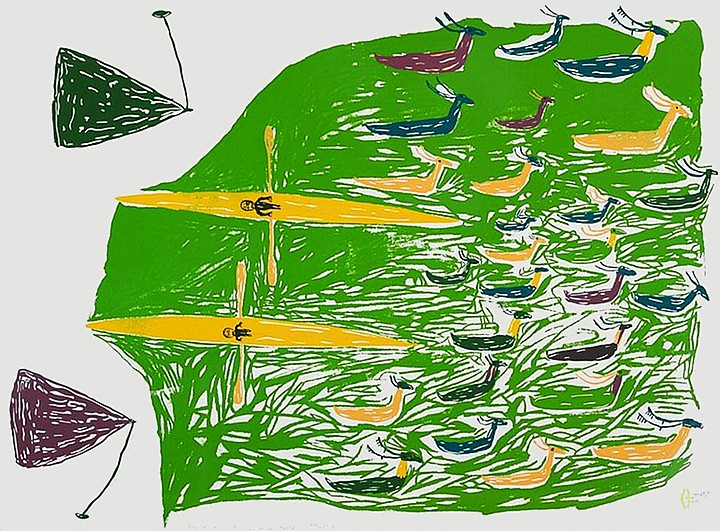
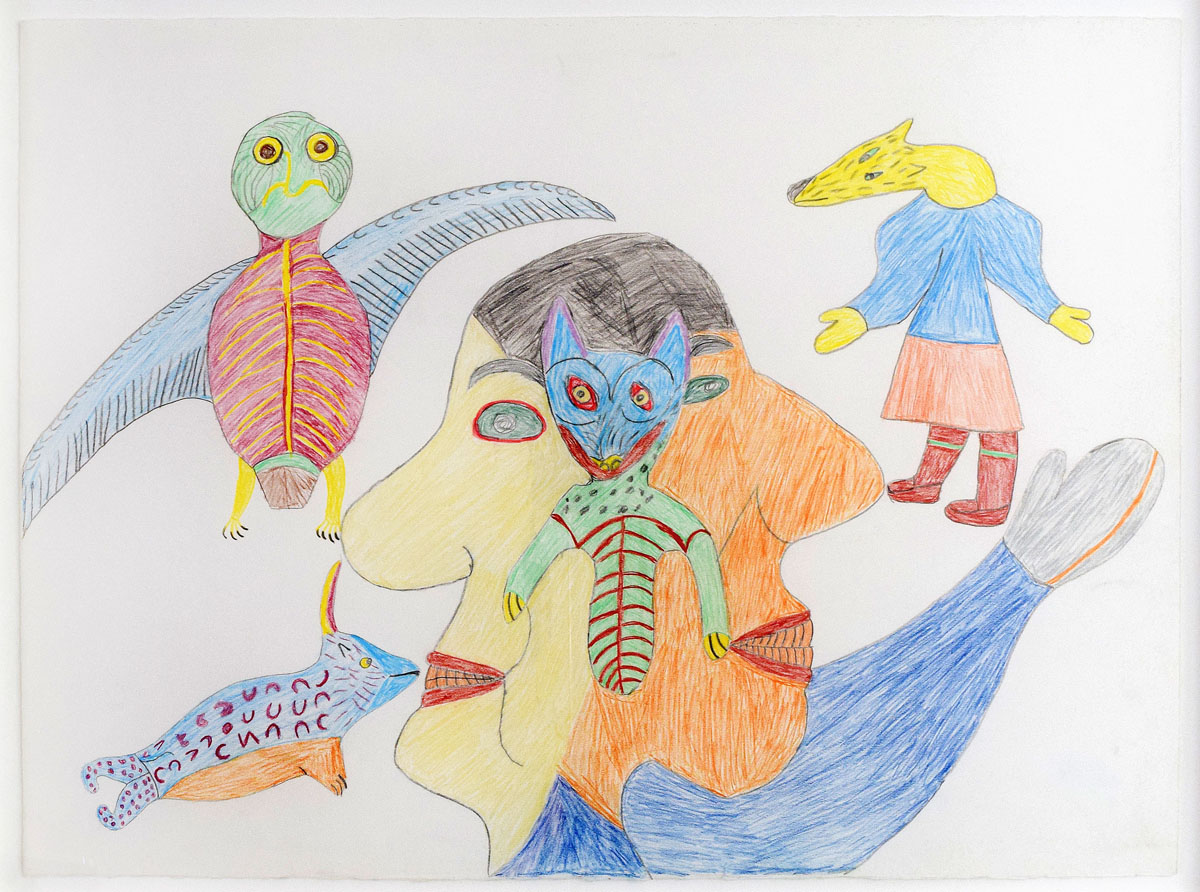
The majority of
Oonark’s compositions draw upon traditional Utkusiksalingmiut culture,
both thematically and in terms of their singular formal sensibility.
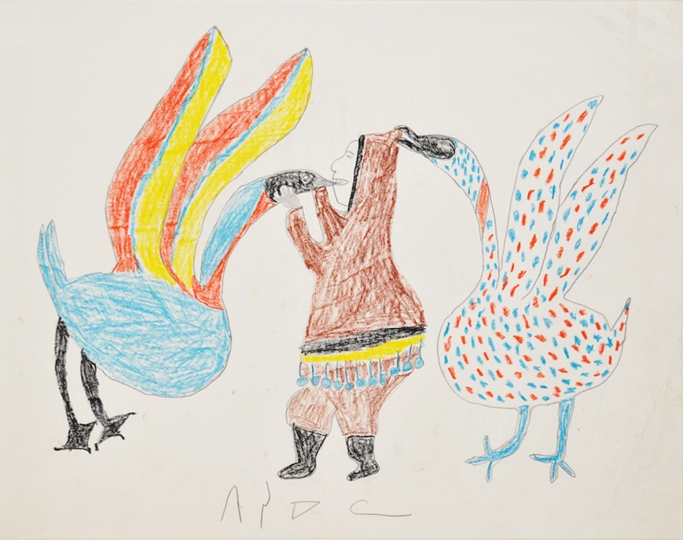
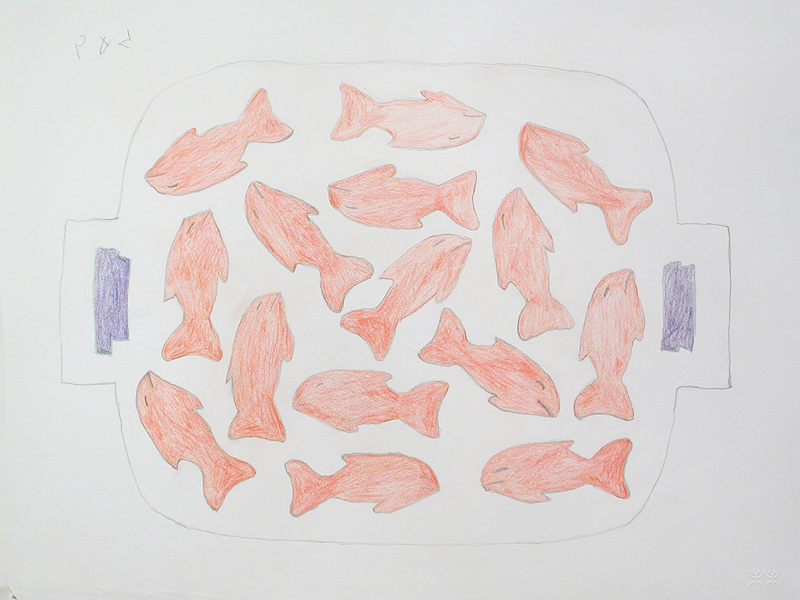
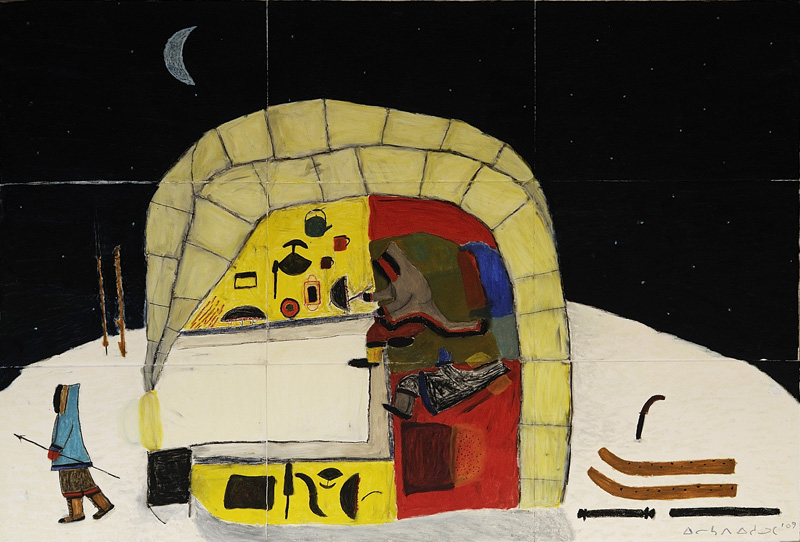
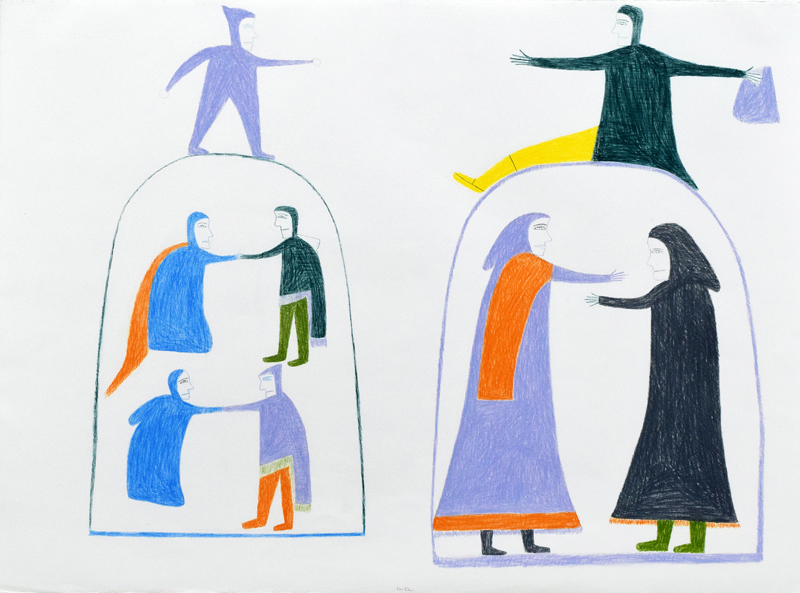
In her textiles and works on paper, Oonark’s visual mode
is one that relies heavily on pattern and the expressive use of
contoured and straight lines to form semi-decorative images of
near-abstract power. Most compositions feature stripe-like sections
of contrasting light-and-dark colour, recalling the strong figure-ground
contrasts that are a defining feature of traditional caribou clothing
design. Oonark’s emphatically formal approach reached its
highest expression in the great hieratic wallhangings of the late
1970s and early 1980s, works marked by a complex use of symmetry,
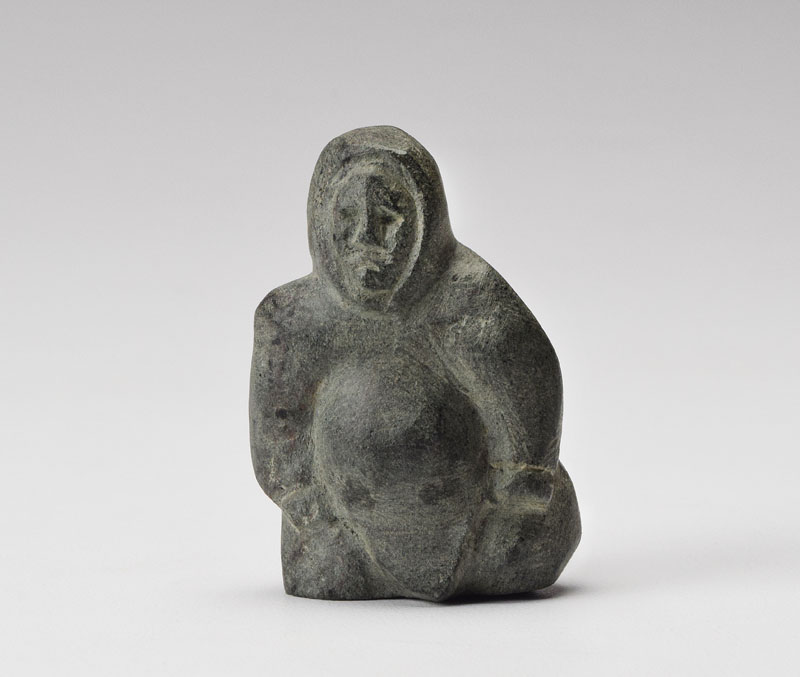
bold colour and scale. Her subjects include animals, humans, birds
and spirits. Oonark was particularly interested in traditional
clothing design, often portraying different regional variations
with the knowledge of an expert practitioner. As Peter Millard
notes, the image of the woman is predominant in many of Oonark’s
iconic compositions: “In drawing after drawing, she is presented
with such centrality and power as to suggest majesty rather than
domesticity.” Many works feature the distinctive crescent
image of the ulu (woman’s knife), presented as a
potent symbol of gendered power and status.
 |
|
Selected
Press
...
VANCOUVER
SUN
Gallery Exhibitions
Selected Other Exhibitions
...
Inuit Modern: The Samuel and Esther
Sarick Collection, Art Gallery of Ontario, Toronto ON,
April 2 - August 21, 2011
...
The Power of Dreams,
Winnipeg Art Gallery, Winnipeg MB, 2004
...
Power of Thought: The Prints of Jessie Oonark, Marsh
Gallery, University of Richmond, Richmond VA, January 11 - February 24, 2002
...
Inuit Imagination: Art and Culture from the Canadian Arctic,
Galleria d’Arte Moderna e Contemporanea, Verona IT,
1995
...
Inuit Women: Life and Legend in Art, Winnipeg Art Gallery,
Winnipeg MB, 1995-1996
...
Qiviuq: A Legend in Art,
Carleton University Art Gallery, Ottawa ON, 1995
...
Qamanittuaq (Where the River Widens): Drawings by Baker
Lake Artists, Macdonald
Stewart Art Centre, Guelph ON, 1994
...
Jessie Oonark: Selected Works from the Permanent Collection, National
Gallery of Canada,
Ottawa ON, 1993
...
Jessie Oonark: A Retrospective, Winnipeg
Art Gallery,
Winnipeg MB, 1988
...
The Inuit Amautik: I Like My Hood to Be Full, Winnipeg
Art Gallery, Winnipeg MB, 1980
...
Oonark/Pangnark, National
Museum of Man, Ottawa ON, 1970
Public Collections
...
Art Gallery of Ontario (Toronto, ON)
Canadian Museum of Civilization (Gatineau, QC)
Heard Museum (Phoenix, AZ)
McMichael Canadian Art Collection (Kleinburg, ON)
Museum of Anthropology (Vancouver, BC)
National Gallery of Canada (Ottawa, ON)
Winnipeg Art Gallery (Winnipeg, MB)
Selected References
...
Jean
Blodgett & Marie Bouchard, Jessie Oonark: A Retrospective,
Winnipeg: Winnipeg Art Gallery, 1986
...
Marie
Bouchard, "Old Master: Oonark," Inuit
Art Quarterly, Winter
1987
...
Marie
Bouchard, "Jessie Oonark, RCA, OC: Retrospective ," Inuit
Art Quarterly,
Winter 1987
...
Marion
Jackson, Judith Nasby and William Noah, Qamanittuaq
(Where the River Widens): Drawings by Baker Lake Artists, Guelph:
Macdonald Stewart Art Centre, 1994.
Gallery Information
...
MARION
SCOTT GALLERY
2423 GRANVILLE STREET
VANCOUVER, BC CANADA V6H 3G5
TEL: 604.685.1934
FAX: 604.685.1890
ART@MARIONSCOTTGALLERY.COM |